() focuses on how the English language is used to create meaning in print and digital texts of varying complexity. Literary texts selected for study are drawn from the past and present, from Australia and other cultures and comprise many text types, including media texts for analysis of argument. The study is intended to meet the needs of students with a wide range of expectations and aspirations, specifically those for whom English is an additional language.
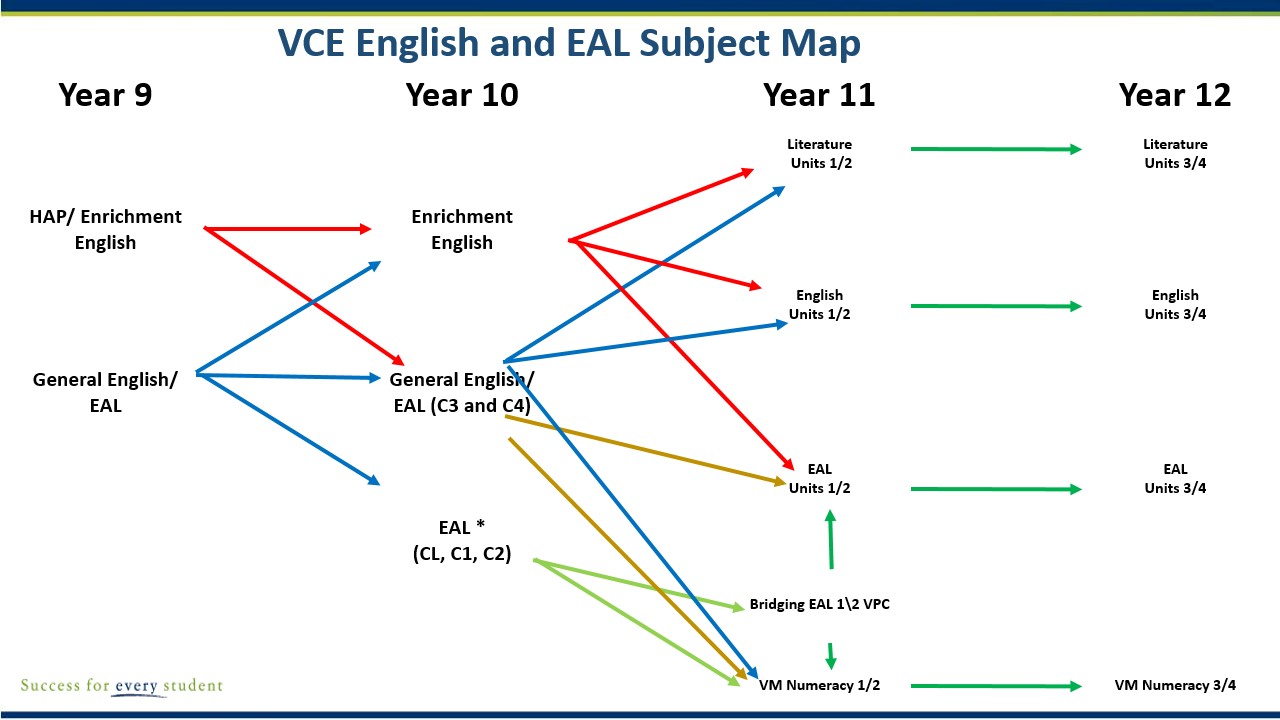
To be eligible to study a student must satisfy both of the following conditions: The student has been a resident in Australia for a period, not more than seven (7) calendar years immediately before 1st of January of the year in which 3 & 4 are undertaken. English has been the student’s primary language of instruction for a total period of no more than seven (7) years before the commencement of the year in which Units 3 & 4 are undertaken.
Students make personal connections with and explore the vocabulary, text structures, language features, and ideas in a text.
Students demonstrate an understanding of effective and cohesive writing through the crafting of their own texts designed for a specific context and audience to achieve a stated purpose, and to describe individual decisions made about selected vocabulary, text structures, language features and conventions used during writing processes. Assessment task: Two student-created texts such as: short stories, speeches, essays, podcasts, poetry/songs, feature articles, and memoirs. A set of annotations on the student- created texts, identifying the qualities of effective writing.
Students consider how arguments are developed and delivered in many forms of media. Students read, view, and listen to a range of texts that attempt to position an intended audience in a particular context. They closely examine the language and visuals employed by the author and offer analysis of the intended effect on the audience. Assessment task: written analytical essays and oral tasks which include discussions, debates and dialogues as well as individual oral presentations.


