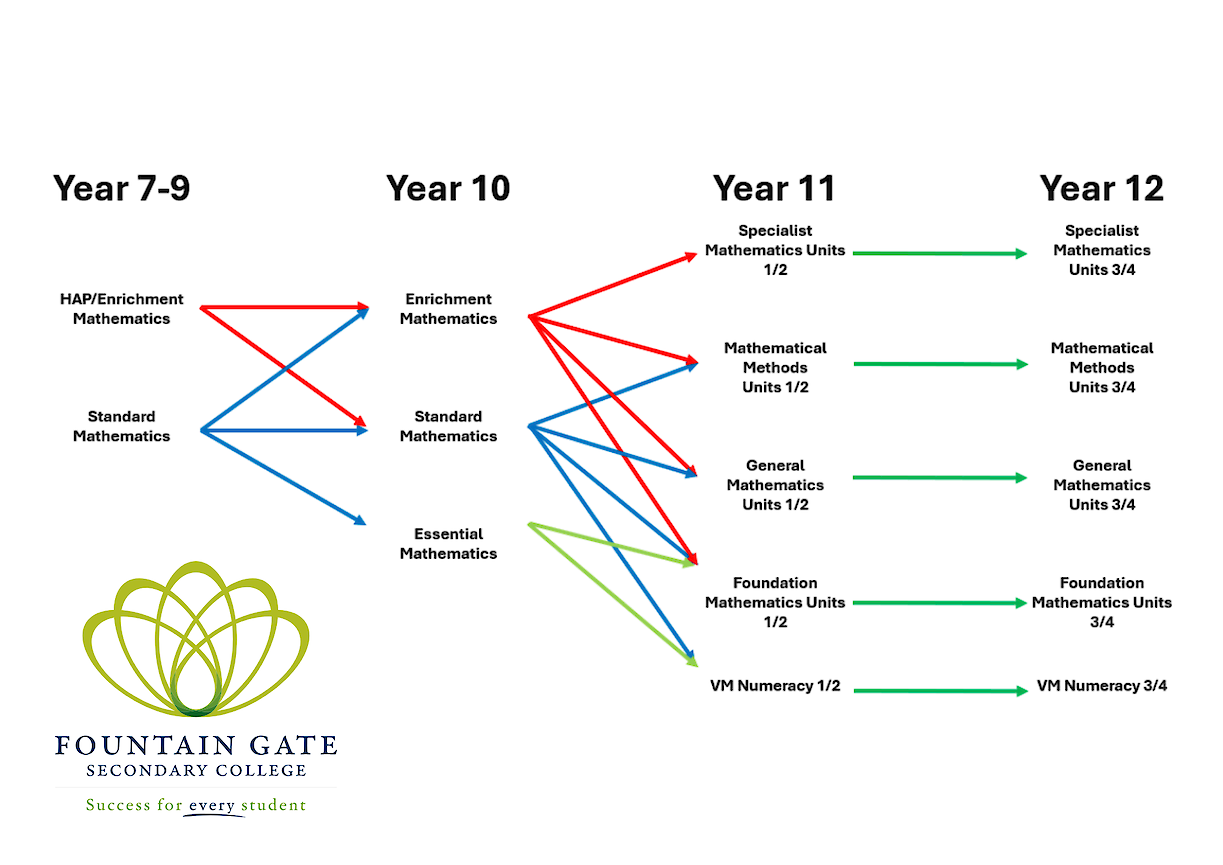
Students are placed in a mathematics class based on their data, needs and eligibility. The two potential class options are:
General Mathematics
Enrichment Mathematics
All Mathematics classes pathway into General or , and build a strong foundation in the six curriculum strands: Number, Algebra, Measurement, Space, Statistics, and Probability. Students develop problem-solving skills, mathematical fluency, and the ability to apply concepts to real-world contexts.
What you will learn in each strand
Number: Work with integers, fractions, percentages, rates and recurring decimals. Use estimation and mental strategies in context.
Algebra: Simplify expressions, expand and factorise, solve equations, and model relationships with tables, graphs, and rules.
Measurement: Solve problems involving length, area, surface area, and volume. Use correct units, conversions, and scale.
Space: Investigate 2D and 3D shapes, apply congruence and similarity, and solve problems using Pythagoras’ Theorem and trigonometry.
Statistics: Collect and analyse data using graphs (e.g. histograms, box plots), and describe data using mean, median, mode, and range.
Probability: Model chance with experiments and calculations using Venn diagrams, two-way tables, and probability trees.
Right-Angled Triangles (Pythagoras’ Theorem and trigonometric ratios)
Measurement (surface area and volume)
Ways You Will Learn
Each term, there is a theme-based Visuals and digital tools (e.g. Desmos)
Hands-on activities, group work, class discussions
Real-world problems and modelling
Practice through checklists and worksheets task.
How You'll Show Your Learning
Solving problems and explaining your thinking clearly.
Creating and interpreting graphs and data displays.
Accurately identifying and applying formulas.
Completing regular formative tasks and quizzes.
Assessment Tasks
Each term, there is a theme-based assessment task
Future School Pathways
Year 9 forms a critical foundation for future study in mathematics, with a strong focus on problem-solving, reasoning, and the application of skills to real-world contexts.
It prepares students for further mathematical learning in Year 10 and beyond, supporting success in a wide range of academic and vocational pathways.