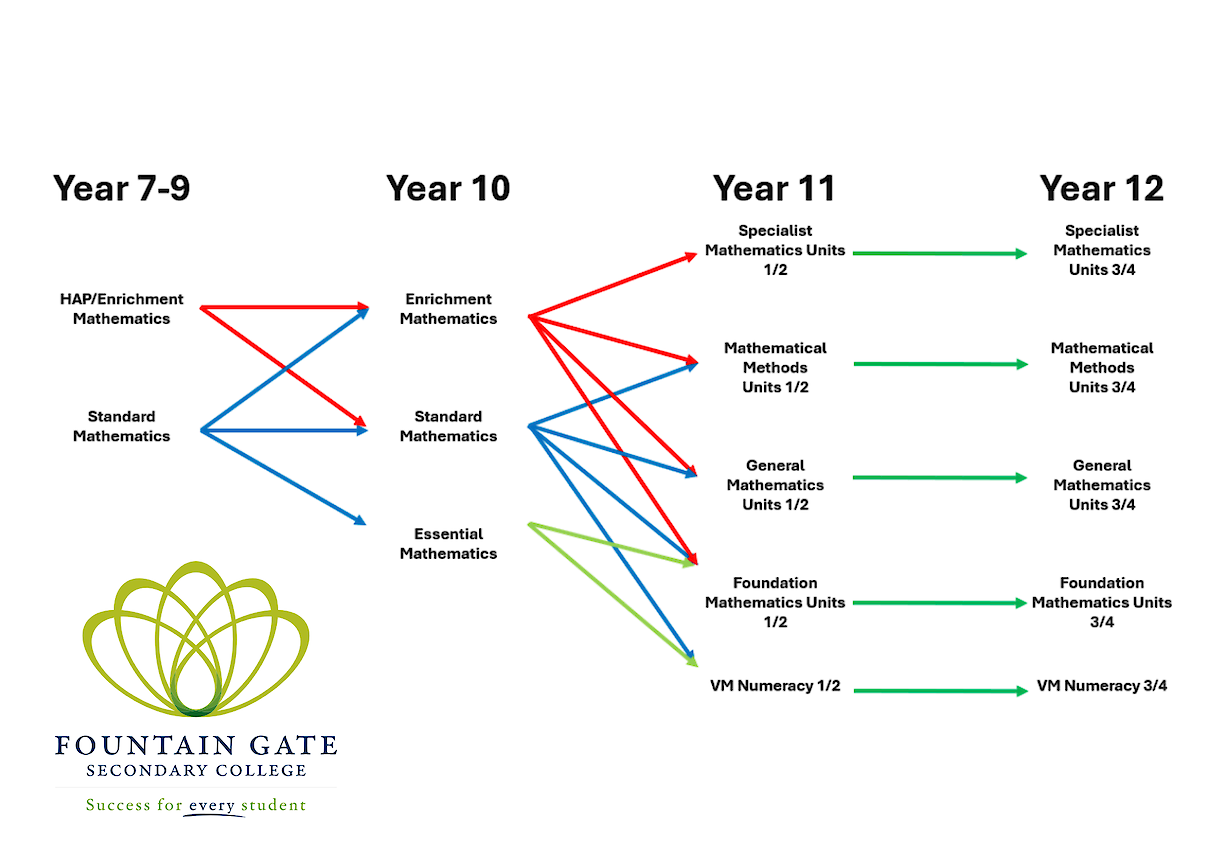
Students are placed in a Mathematics class based on their data and needs. The three potential class options are:
All General and Enrichment Maths classes pathway into General or , however Enrichment Maths is the recommended pathway for Maths Methods. Specialist Maths has the prerequisites of Enrichment Maths.
Applied Foundation Maths best leads to Literacy and may not prepare students for Maths.
Year 10 Mathematics focuses on deepening students' understanding of number, algebra, measurement, space, statistics, and probability. Students apply mathematical techniques to real-world and theoretical problems, develop reasoning and problem-solving skills, and use digital technologies where appropriate. The emphasis is on preparing students for senior mathematics pathways and practical application of concepts.
At Fountain Gate, we use an integrated approach in Mathematics that involves teaching mathematical concepts across different strands (such as number, algebra, measurement, space, statistics, and probability) in a connected and cohesive way, rather than in isolation. This method emphasises real-world applications and encourages students to use multiple mathematical skills to solve complex, authentic problems.
For example, a project might involve budgeting for an event (number, algebra), designing a floor plan (measurement, space), and analysing survey results (statistics, probability). Students see how mathematical concepts work together in meaningful contexts, which strengthens understanding, promotes critical thinking, and supports .